
Roof Rat Droppings: Identification, Health Risks, and What to Do Next
Most homeowners don’t see the rat first.
They see the pellets.
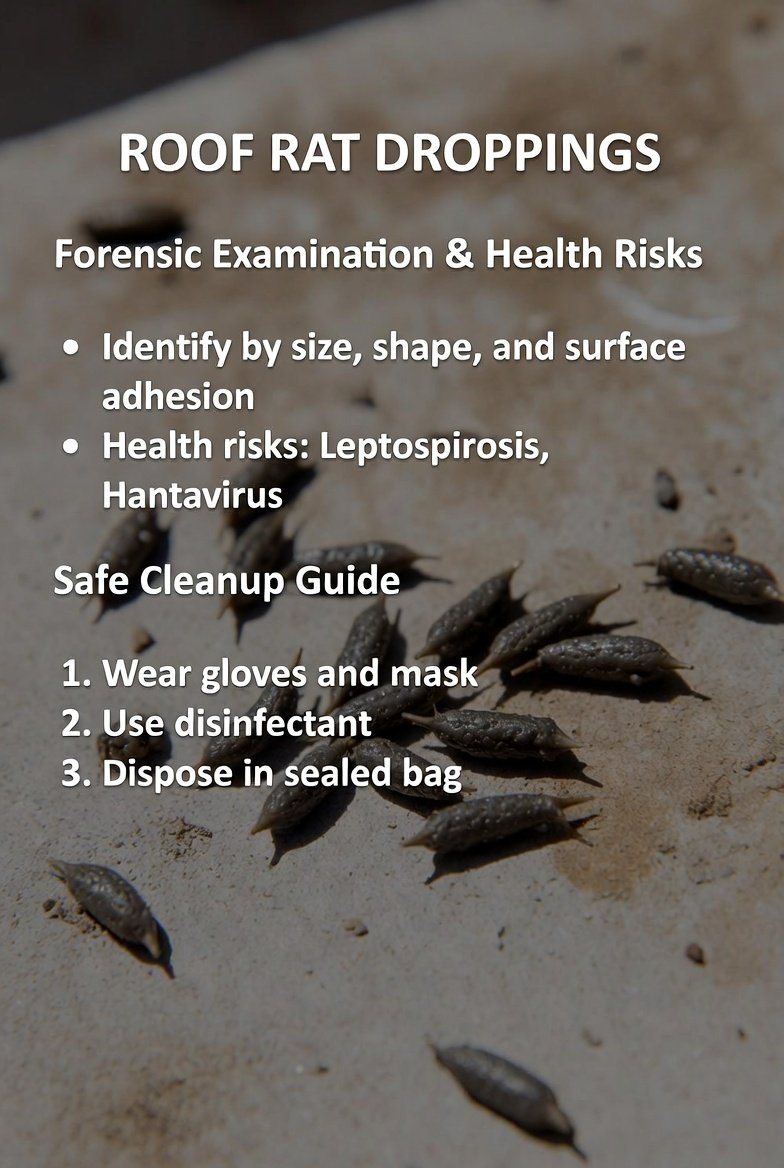
Dark. Capsule-shaped. Scattered along rafters or insulation.
Before cleaning anything, confirm one thing:
Are these actually roof rat droppings?
Species identification changes everything about risk, cleanup, and what to do next.
Quick ID Snapshot (Fast Confirmation)
Typical Length: 10–20 mm (≈ ½–¾ inch)
Shape: Capsule with slightly pointed ends
Location: Elevated (attics, rafters, top of ducts)
Fresh Appearance: Dark, glossy
Old Appearance: Faded gray, brittle
Most Likely Scenario: Elevated droppings + night scratching = roof rats
If droppings match this and appear overhead, roof rats are highly likely.
For species context:
Roof rats
Forensic Identification Guide
1️⃣ Measurement Matters
Roof rat droppings measure:
- 10–20 mm long
• 4–6 mm thick
• Slightly tapered ends
Anything significantly smaller (3–8 mm) is likely mouse.
Anything thicker and blunt-ended may indicate Norway rat.
2️⃣ Location Logic (Often Overlooked)
Roof rat droppings are usually found:
- Along attic rafters
• On insulation runways
• Near roof vents
• On elevated beams
Ground-level droppings near foundation edges usually indicate Norway rats.
Common Misidentifications (Don’t Get This Wrong)
Often Confused With | How It’s Different | Quick Clue |
Bat guano | Crumbly, sparkly when crushed | Found under roost clusters |
Mouse droppings | Much smaller (3–8 mm) | Rice-sized |
Squirrel droppings | Larger, more rounded | Often near chew debris |
Lizard droppings | White uric acid tip | Common in warm states |
Bat guano is especially misidentified in attics.
If droppings crumble into powder easily, consider bat presence.
Fresh vs Old Roof Rat Droppings
Indicator | Fresh | Old |
Color | Dark black | Gray/faded |
Texture | Soft | Dry/brittle |
Shine | Glossy | Dull |
Smell | Slight ammonia | Minimal |
Monitoring Method (48–72 Hour Test)
After cleaning visible droppings:
- Place white paper strips near prior clusters.
- Leave undisturbed for 48–72 hours.
- Recheck for new droppings.
New droppings = active infestation.
If active, follow:
How to get rodents out of attic
Contamination Risk: It’s About Disturbance
Droppings alone are not the primary risk.
Risk increases when:
- Dried droppings are disturbed
• Insulation is shaken
• Dust becomes airborne
Attics amplify risk because:
- Airflow is limited
• Insulation fibers trap contaminants
• HVAC ducts may circulate dust
Contamination Severity Scale
Level | Condition | Risk | Action |
Light | Few pellets | Low | DIY cleanup |
Moderate | Clustered droppings | Moderate | PPE required |
Heavy | Multiple clusters + odor | Elevated | Removal + cleanup |
Severe | Insulation saturation | High | Professional remediation |
For attic-specific contamination logic:
Rat poop in attic
Safe Cleanup Protocol (Correct Order)
Never dry sweep or vacuum untreated droppings.
Step 1: Confirm Removal First
If fresh droppings appear daily, resolve infestation before cleaning:
Rodent removal
Step 2: Ventilate
Step 3: PPE
Minimum:
• Gloves
• Eye protection
• N95 respirator (or higher for heavy contamination)
Step 4: Disinfect Before Handling
Lightly spray droppings and allow 5–10 minutes soak time.
Step 5: Remove Carefully
- Wipe with disposable materials
• Double-bag waste
• Disinfect surfaces again
Three Cleanup Mistakes That Increase Risk
- Dry vacuuming untreated droppings
- Sweeping without wetting first
- Pulling insulation before containment
These actions increase airborne particles.
When Insulation Must Be Replaced (Break-Even Logic)
Insulation acts like a sponge.
Replace insulation if:
- Contamination covers >25% of area
• Strong ammonia odor persists
• Insulation is matted or tunneled
• Urine saturation is visible
Coverage Level | Recommendation |
<10% | Spot clean |
10–30% | Partial removal |
>30% | Full removal often more cost-effective |
Cost Expectations (2026)
Light cleanup only: $150–$400
Removal + exclusion: $600–$1,500+
Insulation replacement: $500–$2,000+
Severe contamination may exceed $3,000.
Limitations (Important)
Photos alone are not enough for species confirmation.
Confirm using:
- Measurement
• Location
• Reappearance monitoring
• Sound patterns
If scratching continues at night:
Animal in attic scratching at night
Why Droppings Reappear
Because:
- Entry points weren’t sealed
• Tree limbs remain
• Nesting continues
• Secondary access gaps exist
True resolution requires:
Removal → Exclusion → Cleanup
Not cleanup alone.
Decision Matrix
Old droppings only → Clean + monitor
Fresh daily droppings → Remove + exclude
Heavy contamination → Remediation required
Bottom Line
Roof rat droppings are diagnostic evidence.
If pellets measure 10–20 mm, are elevated, and slightly pointed, roof rats are likely.
Confirm activity.
Remove infestation.
Clean safely.
Order matters.