
Average Cost of Termite Treatment: What It Really Costs (and Why Quotes Vary So Much)
Average Cost of Termite Treatment
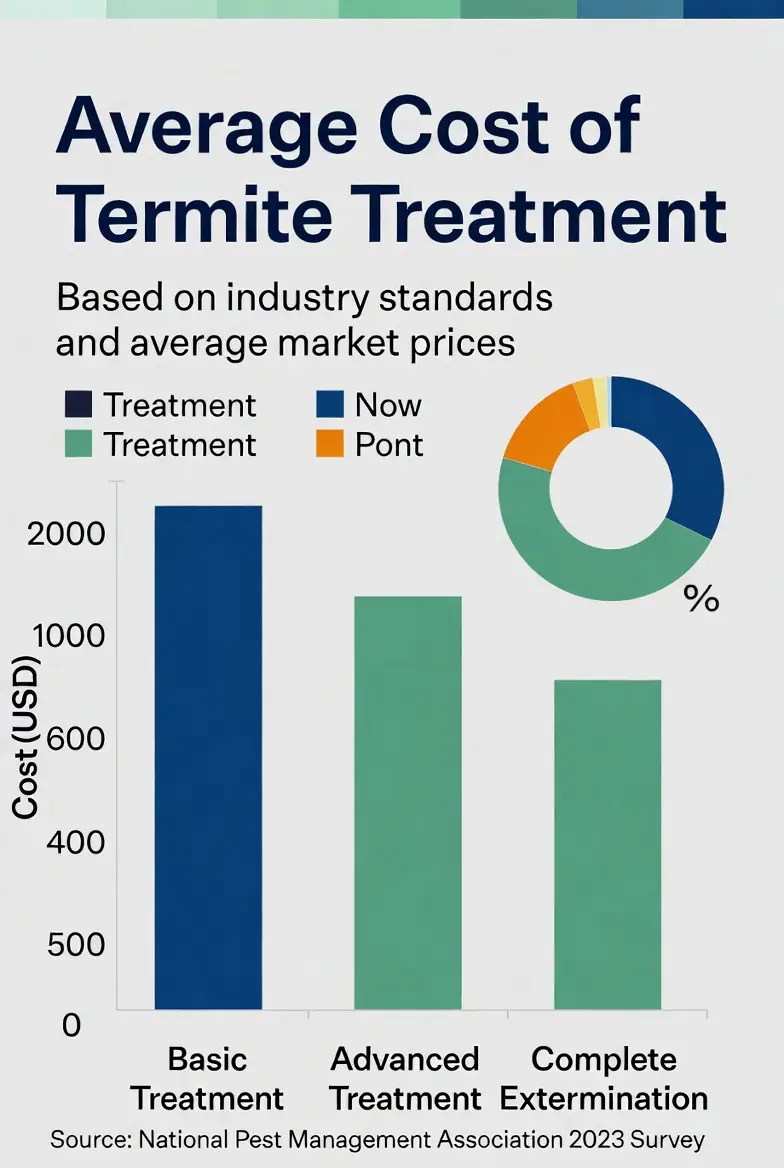
Most termite treatment bills land in the hundreds-to-low-thousands range, but total cost is driven by termite type + method + scope—so the best “average” is the one tied to your method (bait, barrier, fumigation) and your home’s size/access.
Why “average cost” is misleading (and how to use it without getting burned)
People want a simple number. But termite treatment isn’t one product—it’s a strategy applied at different scales.
Two homes can both “have termites,” yet one needs a localized approach while another needs full-perimeter protection or fumigation. That’s why national averages can look calm while real quotes can feel shocking.
A better pricing mindset is:
Which termite type is involved?
Which method is being proposed and why?
What’s the scope—spot, perimeter, or whole-structure?
What follow-up costs exist (Termite Bond and Warranty)?
This page gives you ranges that stay honest—and a quote checklist that keeps you in control.
Average termite treatment cost (common national anchors)
These are the consumer-facing “typical” ranges you’ll see cited across markets:
HomeAdvisor lists an average around $621, with a common range of $263–$1,032 for termite treatment.
Their related pricing summaries note typical treatments around $230–$1,000, while severe cases requiring fumigation can run much higher (into the thousands).
Use these as a starting anchor only. The real number comes from the next sections.
Cost by termite type (this is why methods—and prices—change)
Termite Swarmers vs Flying Ants How to Tell the Difference
Even if you don’t know the termite type yet, this table helps you interpret quotes.
Termite type cost tendencies
Termite type Typical approach How it affects cost
Subterranean Liquid soil barrier and/or bait monitoring Often priced by perimeter/linear footage; drilling/trenching can raise cost
Drywood Localized wood treatments or whole-structure fumigation in some cases Can jump to “thousands” if fumigation is chosen
Dampwood (less common) Address moisture source + localized treatment Moisture repair can be a hidden cost driver
EPA describes common termite control categories such as soil-applied liquid termiticides and bait systems, which is why subterranean termites often map to those methods.
Cost by method (the cleanest way to classify any quote)
Termite treatment price ranges by method
Method Best for Typical pricing behavior
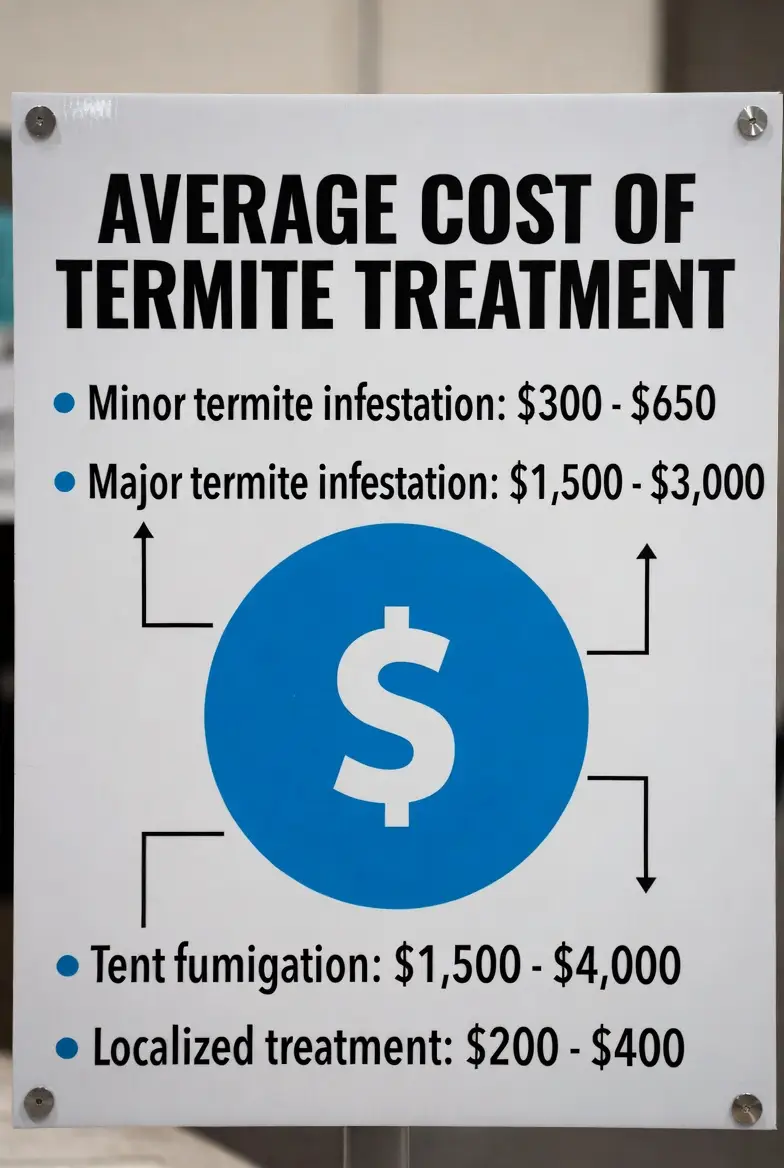
Spot / localized treatment Small, confirmed area Often “few hundred” in many markets (scope matters)
Liquid barrier / soil treatment Subterranean protection Mid-hundreds to a few thousand depending on perimeter + drilling needs
Bait system (monitor + bait) Ongoing monitoring approach Angi cites $8–$12 per linear foot and notes added costs/visits may apply
Whole-structure fumigation Some drywood scenarios / widespread activity HomeAdvisor notes ranges like $1,500–$8,000 for fumigation cases
Key point:
method is the “pricing language.” If a company won’t name the method clearly, you can’t compare bids.
Cost by home size / scope (a practical estimator table)
This isn’t precision. It’s a reality check.
Home size cost tendencies (general guide)
Home size (rough) What changes What to expect
Small
(condo/small house) Less perimeter, fewer access points Often closer to the low end of typical ranges
Medium
(typical single-family) Standard perimeter and attachments Most “average” stats loosely reflect this group
Large
complex (multi-level, additions) More linear footage + more variables Higher total; more likely to include drilling/trenching
For barriers and bait systems, the quote often scales with linear footage/perimeter more than square footage.
Inspection vs treatment cost (don’t mix them up)
A lot of “how much does termite treatment cost?” searches are actually people trying to price the inspection.
An inspection is about confirmation and scope.
Treatment is the action plan and materials/labor.
If you haven’t had an inspection yet, start there—otherwise you’ll compare quotes based on guesses and end up paying for the wrong method.
(And yes—some companies advertise “free inspections,” but the scope and incentives vary. Treat it like a lead-in, not a guarantee of thoroughness.)
The 7 biggest cost drivers (what changes your bill the most)
Termite cost drivers
Driver Why it changes total cost What to ask
Termite type Determines method “Subterranean or drywood—what evidence supports that?”
Method Each method has different labor/material cost “Barrier, bait, fumigation, or spot—and why?”
Scope Spot vs perimeter vs whole-structure “Which areas are included/excluded?”
Drilling/trenching Adds time/equipment “Is drilling needed? Where and how much?”
Access constraints Crawl spaces/attachments slow work “Any access issues affecting price?”
Follow-up visits Especially for bait/monitor plans “How many visits are included?”
Termite Bond and Warranty/bond structure Renewal costs can be real “What renews annually and what does it cover?”
Warranty/bond and renewals (the hidden cost people miss)
This is where “cheap” becomes expensive later—especially with monitoring-style plans.
Question Why it matters
“Does it cover retreatment, repairs, or both?” Many cover retreatment only
“What’s the renewal cost and schedule?” Ongoing cost can exceed initial
“What voids coverage?” Landscaping, drainage neglect, remodel changes can matter
If you’re buying a bait plan, clarify monitoring cadence and renewal terms up front—Angi explicitly notes added visits/costs may apply depending on the plan.
How to compare termite quotes (copy/paste checklist)
Send this to each company:
What termite type are you treating and what evidence supports it?
What method are you recommending (bait, barrier, fumigation, spot)?
What is the scope (spot/perimeter/whole-structure)? What areas are included?
Is drilling/trenching included? Where and how much?
How many follow-up visits are included?
What does the warranty/bond cover, and what renews annually?
What conditions void coverage?
This turns your decision into “scope comparison,” not a price guessing game.
Common upsells and how to sanity-check them (calmly)
You don’t need to assume bad intent. But you should verify.
Typical upsells
“Extra drilling locations” without clear justification
“Additional stations”
(bait systems) without explaining layout logic
“Immediate upgrade to whole-house”
without showing evidence scope
“Moisture add-ons”
that might be helpful—but should be separated as a different project
Sanity check rule
If an add-on matters, the provider should be able to answer:
What problem does this solve?
What evidence suggests it’s needed?
What happens if we don’t do it?
If they can’t, pause.
How much for termite treatment? (absorbed keyword answer)
Most homeowners see termite treatment costs in the hundreds to low-thousands, but it can rise into the thousands when the scope expands or fumigation is needed.
That’s the honest anchor without pretending every home is the same.
Limitations / Drawbacks
Online “average cost” numbers are broad national estimates and may not reflect your local labor rates or construction style.
Different termite types push different methods and costs.
Renewals and monitoring can materially change lifetime cost, especially with bait systems.
Bottom line
Use averages to orient yourself—but decide based on termite type + method + scope + renewals. If your quote includes those four elements in writing, you can compare bids confidently and avoid paying for a plan that doesn’t match your situation.