
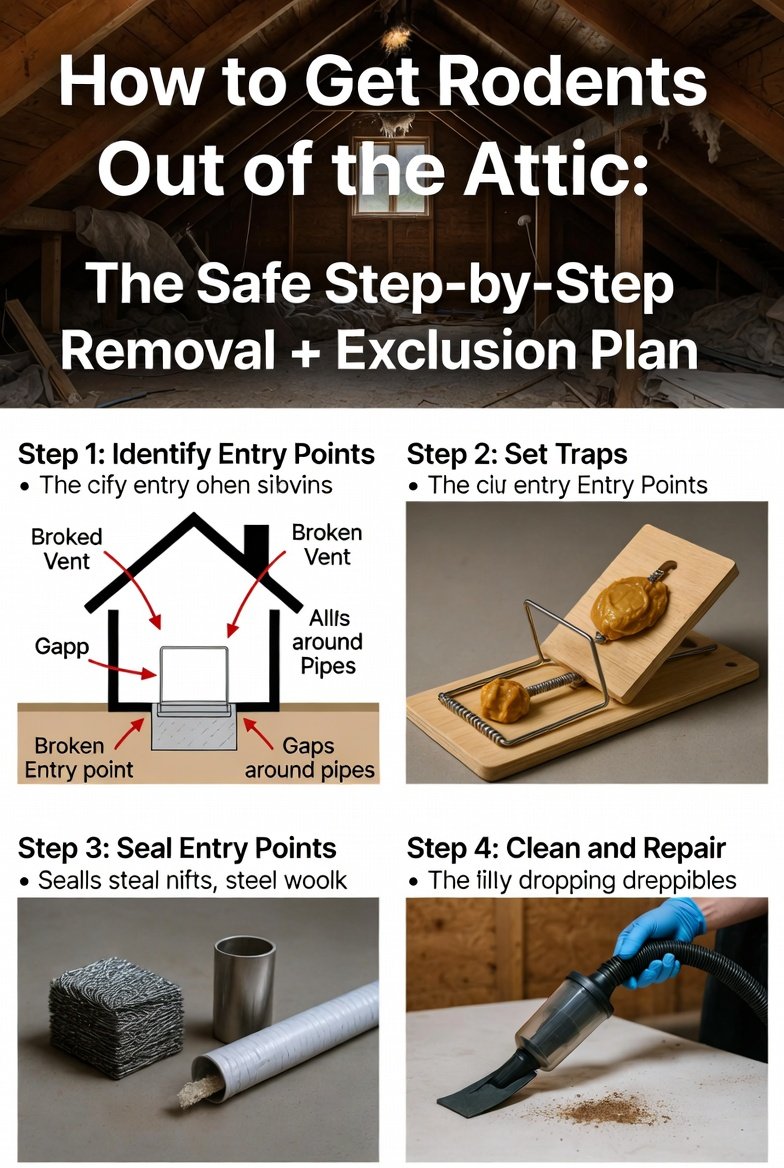
How to Get Rodents Out of the Attic (Without Making the Problem Worse)
Most attic rodent problems get worse for one simple reason:
People try to “solve it fast” in the wrong order.
They seal a hole before the rodents are out.
They toss poison into the insulation.
They vacuum droppings dry.
They chase noises without confirming entry points.
This page gives you a calm, proven sequence that works in real houses.
If you follow the order below, you’ll either (1) remove them successfully yourself, or (2) know exactly when it’s smarter to call a pro—before it turns into a repeat cycle.
Quick Reality Check: What “Getting Rodents Out” Actually Means
Getting rodents out of the attic is not one action. It’s four phases:
- Confirm activity and locate the likely zone
- Remove rodents (traps / one-way methods / pro service)
- Exclude them (seal every entry point)
- Clean + reset the attic so it doesn’t stay attractive
Skip Phase 3 and you’ll often get reinfested. That’s why pros talk about removal + exclusion as a package.
If your main clue is noise timing (especially night scratching), read animal in attic scratching at night first—it helps you avoid chasing the wrong species.
Animal in attic scratching at night
Step 1: Confirm It’s Rodents (Not “Any Animal”)
Fast confirmation checklist
Look for at least two of these:
- Droppings (small “rice” shapes for mice; larger for rats)
• Gnaw marks on wood or stored boxes
• Rub/grease marks near beams or edges
• Disturbed insulation (paths, matted trails)
• Night activity (common with rats/mice)
• Entry clues near roofline vents/soffits
If you’re unsure whether it’s mice vs rats vs squirrels, use the routing page rodent in attic (and don’t guess—methods differ).
Step 2: Stop Feeding the Problem (Before You Trap Anything)
Rodents stay where food + shelter are stable.
Do this immediately:
- Move pet food to sealed containers
• Secure trash lids
• Remove bird seed from near the home
• Fix dripping pipes (moisture increases attic comfort)
This doesn’t “remove” them—but it increases trap effectiveness and reduces reinfestation pressure.
Step 3: Choose the Right Removal Path (DIY vs Pro)
Here’s the real decision boundary.
DIY vs Pro decision table
Situation | DIY is realistic if… | Call a pro if… |
Light activity | You’ve seen small droppings in one zone | Activity is across multiple zones |
Access | You can safely reach attic + set traps | High/unsafe access or steep roofline |
Time | You can monitor traps daily for 7–14 days | You can’t monitor consistently |
Risk | No heavy droppings/contamination | Heavy droppings or strong odor |
Entry points | You can inspect roofline carefully | You can’t locate entry points |
If you’re ready to convert this into a full service workflow (removal + sealing + warranty-style prevention), route to rodent removal—that’s the money page this article should naturally feed.
Step 4: Removal Methods That Actually Work
Method A: Trapping (most reliable DIY option)
- Use multiple traps (rodents rarely travel alone)
• Place traps along walls, beams, and known runways
• Keep traps set for at least 7–14 days after last capture
Do not rely on peppermint, ultrasonic devices, or “scent pouches” as your main removal method—SERP forums love them, real results are inconsistent.
Method B: One-way exits (works only when paired with exclusion planning)
One-way devices can work, but only if:
- You’re confident the entry point is correct
• You have a plan to seal everything else afterward
This is where many DIY attempts fail: rodents find the second gap.
Method C: Professional removal (fastest when activity is established)
Pros typically:
- Confirm species and activity zones
• Set trapping strategy
• Verify declining activity
• Then complete exclusion (seal + reinforce)
That “exclusion step” is why professional jobs cost more—but it’s also why they last.
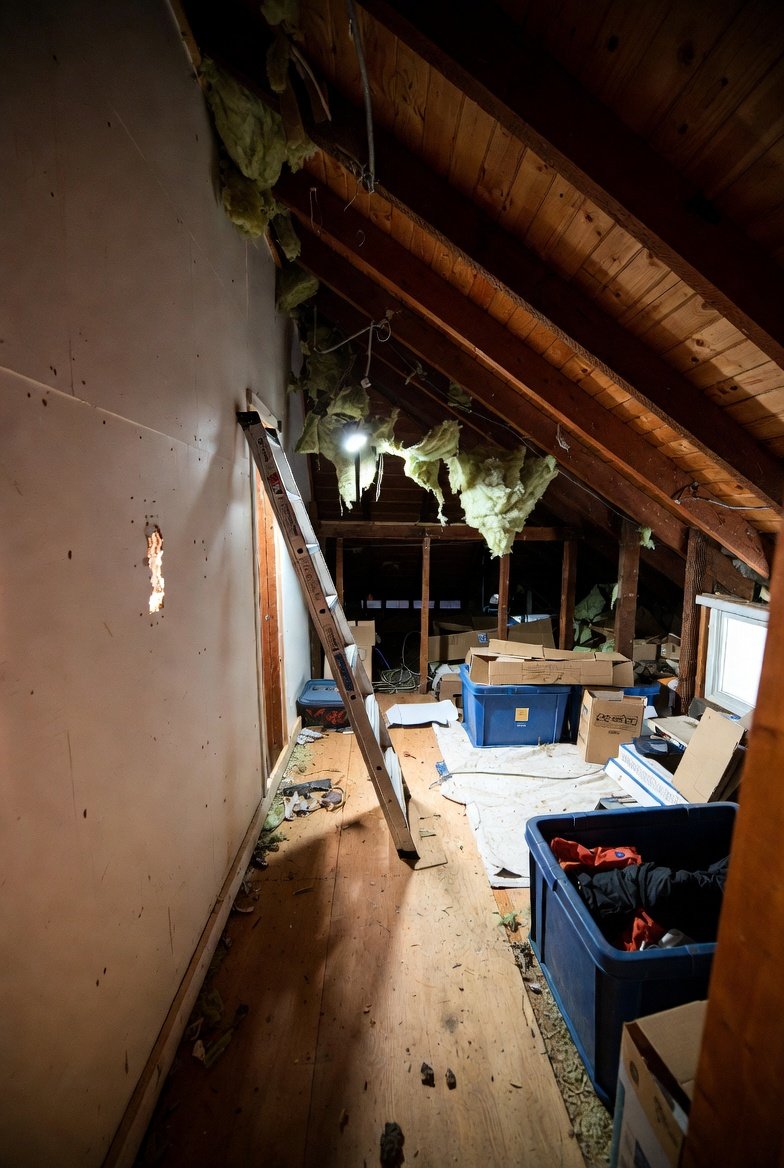
Step 5: Do NOT Seal Entry Points Yet (Here’s Why)
Sealing too early can trap rodents in:
- Wall voids
• Ceilings
• HVAC chases
That can create odor and a harder cleanup.
Rule:
✅ Remove first → ✅ confirm quiet period → ✅ then seal.
If you want the entry-point map used for roofline inspections, see how do rats get in the attic.
Step 6: Exclusion (The Part That Prevents Re-Entry)
Exclusion is sealing with rodent-proof materials, not just caulk.
What to seal (most common attic routes)
- Roof vents and gable vents
• Soffit corners and seams
• Ridge vent breaks
• Utility penetrations
• Fascia gaps and flashing transitions
EPA explicitly recommends sealing holes to prevent infestations.
Material standard (simple, durable)
Use hardware cloth and proper fasteners in vulnerable areas; some public health guidance references 1/4-inch hardware cloth as rodent-proof screening.
(Translation: foam alone is not a long-term solution. Foam is a filler; metal is the barrier.)
Step 7: Clean Up Safely (Don’t Vacuum Dry Droppings)
This is where a lot of “how-to” pages get people into trouble.
CDC guidance is clear: don’t sweep or vacuum rodent droppings until they’ve been disinfected—it can aerosolize contaminated particles.
Safe cleanup sequence (practical version)
- Ventilate attic if possible
• Wear gloves (and ideally a proper respirator if heavy contamination)
• Spray droppings/nesting area with disinfectant, let it soak
• Wipe up with disposable materials and bag waste
• Disinfect again
If the attic insulation is heavily contaminated, removal becomes a separate cost category—often not included in basic rodent removal.
What This Typically Costs (2026-Realistic Ranges)
There are three different “bills” people confuse:
1) Removal (trapping / elimination)
Typical range: about $175–$600 depending on severity and access.
2) Exclusion (seal + reinforce entry points)
Typical range: $600–$1,500+ for most homes with multiple access points; more when roofline work is extensive.
3) Attic remediation (if insulation is contaminated)
Insulation removal alone commonly runs hundreds to over $1,000+ depending on type and area.
Reality: rats usually drive higher costs than mice because access points and contamination tend to be more severe.
For a broader pricing context, see pest control cost estimates.
Expected Timeline (So You Know What “Success” Looks Like)
Timeframe | What you should see |
First 48 hours | Trap interaction or clear activity pattern |
Week 1 | Declining noise/traffic |
Week 2 | Quiet period (no new droppings/trap hits) |
After quiet period | Exclusion work + cleanup |
30 days | Stable attic (no fresh signs) |
If you seal too early or skip exclusion, it often “comes back” the next season.
The Two Biggest Mistakes
Mistake 1: Poison in an attic
You may not know where the rodent dies, and cleanup becomes harder.
Mistake 2: Closing one hole and assuming it’s done
Rodents test multiple seams. Exclusion must be systematic to hold.
Calm Next Step (No Pressure, Just Clarity)
If you want the fastest, lowest-repeat outcome, the most efficient path is:
confirm → remove → exclude → reset
And if you’re already seeing recurring activity, jumping straight to a structured service approach (removal + exclusion) is usually cheaper than “DIY attempts + a second cleanup.”
That’s exactly what rodent pest control services is built to help with.
The Bottom Line
To get rodents out of an attic for good, you need two wins:
- Remove the current animals
• Make the attic unenterable and unattractive afterward
Do it in the correct order, and the problem usually stabilizes fast.
Do it out of order, and the cycle repeats.