
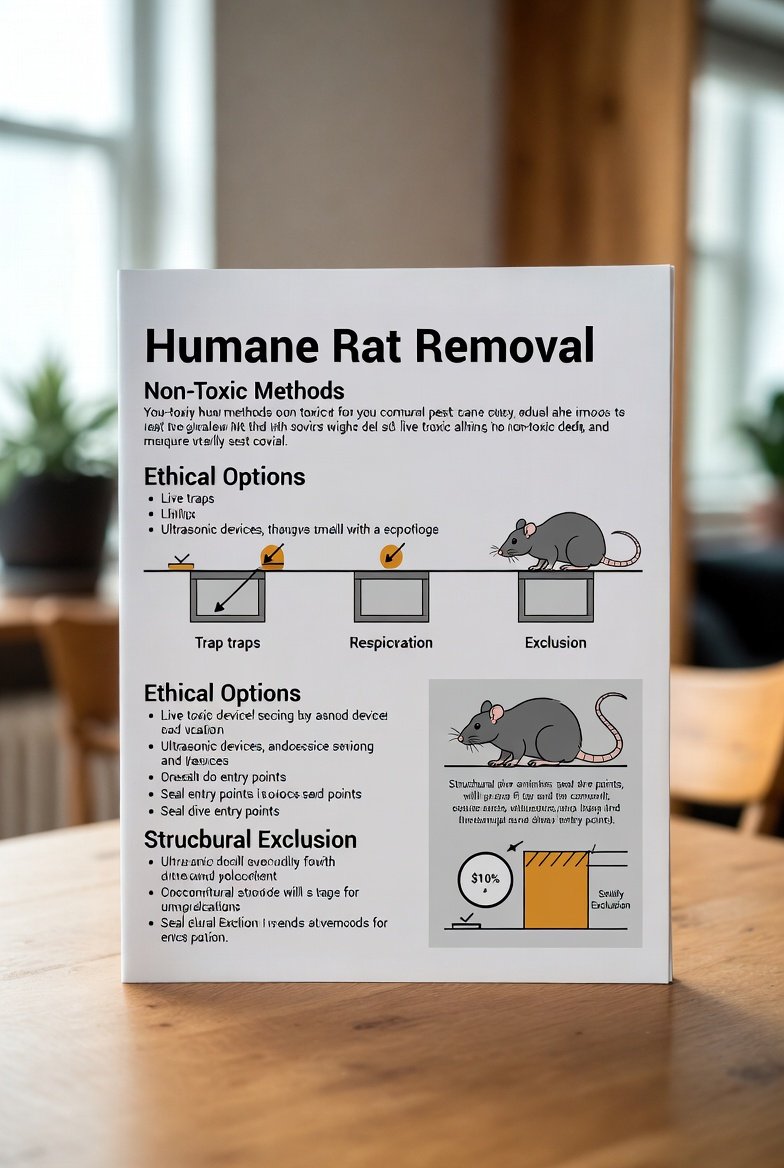
Humane Rat Removal: Ethical, Non-Toxic, and Structurally Effective Methods
Humane rat removal is often misunderstood.
It does not simply mean “don’t kill.”
It means:
- Minimize suffering
• Avoid prolonged toxins
• Prevent recurrence
• Follow correct structural sequence
Ethical intent without structural control leads to repeated infestations.
The goal is resolution without cruelty.
Quick Diagnostic Snapshot
Humane removal begins with:
✔ Confirm active infestation
✔ Identify entry points
✔ Remove before sealing
✔ Avoid poison inside structures
✔ Confirm inactivity (48–72 hours) before full closure
If rats are nesting inside walls:
Sequence determines outcome.
What “Humane” Actually Means
Humane rodent control balances:
- Animal welfare
- Public health
- Structural protection
Humane does not always mean relocation.
In some cases, rapid-kill mechanical traps cause less suffering than prolonged live confinement.
Prevention and exclusion are the most humane long-term solutions.
Humane Removal Decision Ladder
Tier | Method | Humane Impact | Recurrence Risk |
1 | Exclusion + Sanitation | Highest | Lowest |
2 | One-Way Exit Devices | High | Low (if sealed) |
3 | High-Quality Snap Traps | Moderate-High | Low |
4 | Live Trap + Relocation | Variable | High |
Prevention reduces suffering more effectively than repeated trapping.
Scenario Selector — Which Humane Method Fits Your Situation?
Situation | Recommended Humane Approach |
Single rat sighting indoors | Snap trap + monitor + inspect entry |
Rats in attic runways | One-way exit + seal after confirmation |
Nest confirmed in wall | Mechanical traps + structural exclusion |
Pets/kids present | Avoid poison; enclosed snap traps only |
Recurring infestations | Full professional exclusion |
Unknown entry points | Removal first, then comprehensive inspection |
Tier 1 — Exclusion & Environmental Control (Most Humane Long-Term)
Rats cannot remain where access is eliminated.
Minimum Humane Exclusion Spec:
- ¼-inch galvanized hardware cloth
• Metal flashing (not foam alone)
• Rat-proof vent covers
• Sealed utility penetrations
• Door sweeps on garage entry
• Chimney caps where applicable
Foam without metal backing fails.
Exclusion is permanent prevention.
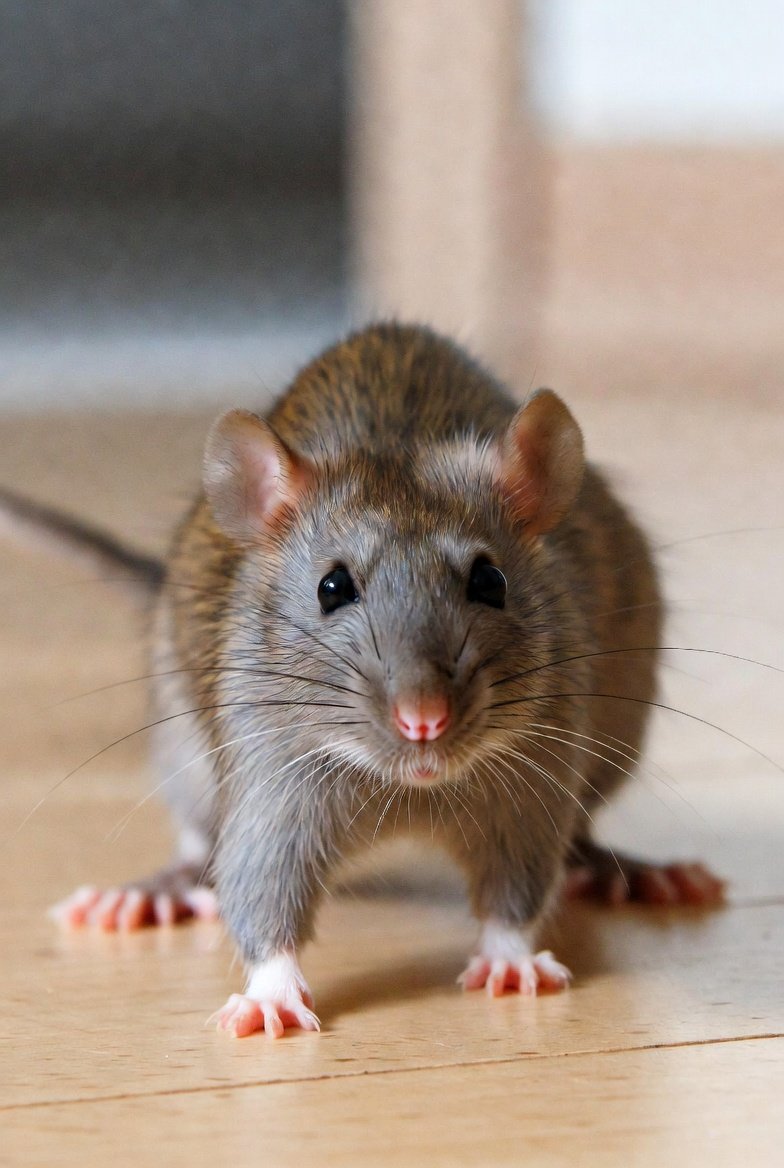
If attic crossover suspected:
animal in attic searching at night
Seal Timing Rule (Critical)
Never fully seal openings until:
- 48–72 hours pass with no new droppings
• Or one-way exit device confirms no re-entry
Sealing too early risks trapping rats inside.
If odor develops afterward:
Tier 2 — One-Way Exit Devices
Best when:
- Primary entry point identified
• Rats primarily using one structural route
Placement Rules:
- Install at confirmed exit hole
• Seal all secondary gaps first
• Monitor activity for 3 days
Failure Signs:
- New droppings after installation
• Scratching persists
• Activity shifts location
If failure occurs, reassess entry network.
Tier 3 — Snap Traps (Humane Kill When Necessary)
High-quality snap traps:
- Cause rapid unconsciousness
• Avoid prolonged toxin suffering
• Prevent secondary wildlife poisoning
• Reduce wall-void decomposition risk
Placement:
- Along wall edges
• Near active droppings
• Behind appliances
• Inside tamper-resistant enclosures
Avoid glue traps.
Avoid internal rodenticide inside structures.
Tier 4 — Live Trapping & Relocation (Reality Check)
Live trapping can be humane only under strict protocol.
Humane Handling Protocol:
- Check traps at least twice daily
• Keep traps shaded and ventilated
• Cover trap partially to reduce stress
• Wear gloves to prevent bites
• Release only where legal and appropriate
Relocation survival rates vary.
Relocation without exclusion leads to repeated intrusion cycles.
Humane intention does not guarantee humane outcome.
Non-Toxic Toolkit
Recommended:
- Mechanical snap traps
• Enclosed bait stations (non-toxic lure)
• One-way exit devices
• Hardware cloth + flashing
• Monitoring cameras
Avoid:
✗ Glue boards
✗ Loose poison bait
✗ Expanding foam without reinforcement
Structural Sequence — Correct Order
1️⃣ Confirm activity
2️⃣ Remove active rats
3️⃣ Confirm inactivity (monitor 48–72 hrs)
4️⃣ Seal all entry points
5️⃣ Clean and remediate
If contamination present:
Skipping removal before sealing causes structural odor issues.
Cost & Break-Even Logic
Approach | Typical DIY Cost | Long-Term Risk |
Basic traps only | $50–$150 | High recurrence |
DIY exclusion materials | $100–$400 | Moderate (skill dependent) |
Professional exclusion | $400–$1,500+ | Lowest recurrence |
Repeated trapping cycles often exceed professional exclusion cost within one season.
For structural removal services:
rodent removal in attic
Common Humane Removal Mistakes
- Sealing before confirming removal
• Relocating without sealing
• Using poison in wall cavities
• Ignoring attic crossover
• Relying solely on ultrasonic repellents
Humane removal fails when structure is ignored.
Limitations & Trade-Offs
Humane removal must balance:
Animal welfare + public health + structural safety.
In some scenarios, rapid-kill mechanical traps reduce suffering more effectively than poorly managed live traps.
Prevention through exclusion remains the highest-welfare outcome.
Decision Matrix
Single intrusion → Snap trap + inspect entry
Identified attic access → One-way exit + seal
Wall nesting → Mechanical removal + exclusion
Recurring activity → Full structural exclusion
Odor present → Remove carcass before sealing
Bottom Line
Humane rat removal is exclusion-first, toxin-minimal, and sequence-driven.
Prevent entry.
Remove actively.
Seal permanently.
Ethical control without structural logic fails.