
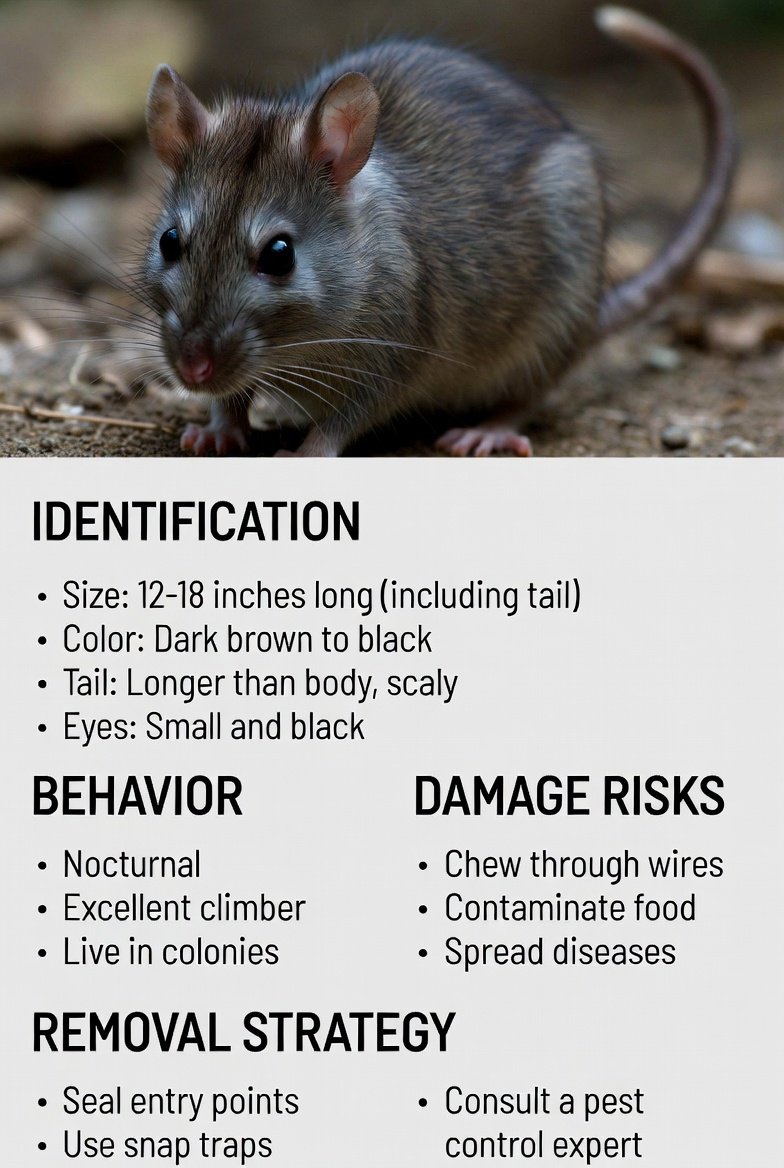
Roof Rats: How to Identify Them, Understand Their Behavior, and Stop Home Intrusion
Roof rats are not “just rats.”
They behave differently.
They enter differently.
They nest differently.
And if you treat them like ground rats, you often fail.
If activity is elevated — ceilings, rafters, roofline — species identification changes your entire strategy.
This guide gives you forensic identification detail, biology insight, and structural prevention logic.
Roof Rat Quick Snapshot
- Scientific name: Rattus rattus
• Common names: Black rat, ship rat
• Body length: 150–200 mm (6–8 in)
• Tail length: 180–250 mm (longer than body)
• Weight: 120–250 g
• Primary nesting zone: Elevated (attics, rafters, trees)
• Most common U.S. regions: Southern states, coastal areas
If scratching is overhead rather than under floors, roof rats become highly likely.
Forensic Identification Guide
1️⃣ Body & Tail Ratio
Roof rats have tails longer than their body length.
Norway rats have shorter tails relative to body.
This is the fastest visual differentiator.
2️⃣ Dropping Measurements
Roof rat droppings:
- 10–20 mm long
• Capsule-shaped
• Slightly pointed ends
Norway rat droppings:
- Larger
• Blunter ends
Mouse droppings:
- Much smaller (3–8 mm)
• Rice-like
If droppings are found in attic insulation, compare with:
3️⃣ Gnaw Height Clue
Roof rats chew higher.
If gnaw marks appear:
- Above 4 feet
• Along rafters
• On upper cabinet corners
Roof rats are more likely.
Norway rats focus lower.
4️⃣ Nesting Behavior
Roof rats:
- Use insulation and soft materials
• Build nests above ground
• Prefer attic corners
Norway rats:
- Burrow
• Nest under slabs or in basements
If nests are elevated, see:
Rat nest in attic
Roof Rat vs Norway Rat vs Mouse (Complete Diagnostic Table)
Feature | Roof Rat | Norway Rat | Mouse |
Body build | Slender | Stocky | Small |
Tail length | Longer than body | Shorter | Equal/short |
Climbing | Excellent | Moderate | Good |
Nest zone | Attic/trees | Burrows | Inside walls |
Dropping size | 10–20 mm | 18–25 mm | 3–8 mm |
Gnaw height | High | Low | Mixed |
Species clarity prevents wrong removal strategy.

Behavior Inside Structures
Roof rats:
- Are nocturnal
• Follow structural edges
• Travel along wires and pipes
• Store food in hidden cavities
• Avoid new objects initially (neophobia)
Neophobia matters.
If traps are placed suddenly, roof rats may avoid them for days.
Best practice:
- Place traps unset for 2–3 days
• Then activate
This is rarely explained in SERP content — but it improves capture rates.
Climbing Mechanics (Why They Access Rooflines)
Roof rats:
- Grip rough surfaces
• Jump horizontally up to 4 feet
• Jump vertically up to 3 feet
• Use cables as highways
Common entry routes:
- Tree limbs 6–8 feet from roof
• Overhanging vegetation
• Utility lines
• Gable vents
For entry logic:
How do rats get in the attic
Lifecycle & Population Growth
Roof rats mature in ~3–4 months.
- Litters per year: 4–6
• Pups per litter: 5–8
• Potential offspring annually per female: 25–40+
In southern climates, breeding may continue year-round.
In colder states, fall migration into homes spikes nesting.
Population growth compounds rapidly if nesting persists.
Contamination & Structural Risk Scale
Attic-Specific Severity Grading
Level | Conditions | Risk |
Light | Few droppings | Low contamination |
Moderate | Nesting + droppings | Insulation compromise |
Heavy | Multiple nests | Fire + health risk |
Severe | Insulation saturation | Remediation required |
Roof rats contaminate insulation and may access HVAC ductwork.
Airflow can move particulates into living space if contamination accumulates.
Electrical & Fire Risk
Roof rats chew continuously to maintain tooth length.
Attic wiring is vulnerable.
If wiring insulation is stripped, fire risk increases.
Escalate if:
- Chew marks on wiring
• Repeated breaker trips
• Burning smell
Geographic & Urban Nuance
Roof rats are more common in:
- Southern U.S.
• Coastal shipping hubs
• Warm climates
Urban fruit trees increase roof rat density.
Palm trees and dense canopy provide highway access.
Suburban homes with roof overhangs are especially vulnerable.
Removal Strategy (Species-Specific)
Correct sequence:
1️⃣ Confirm species
2️⃣ Deploy traps strategically (pre-bait phase recommended)
3️⃣ Confirm activity decline
4️⃣ Seal elevated entry points
5️⃣ Trim vegetation
If infestation is active:
Generic removal without height-focused exclusion often fails.
Hard Escalation Thresholds
Professional removal is strongly recommended if:
- Multiple attic nests are found
• Insulation damage exceeds 25%
• Wiring damage visible
• Seasonal return pattern exists
• Roof pitch is steep or unsafe
Cost Expectations (2026 Ranges)
Removal: $200–$600
Exclusion (roofline): $600–$1,500+
Attic remediation: $500–$2,000+
Severe contamination cases may exceed $3,000.
Why Roof Rat Problems Repeat
Repeat infestations usually happen because:
- Secondary roof gaps remain
• Vent screens weren’t reinforced
• Tree limbs were not trimmed
• Insulation contamination remained
True resolution requires:
Removal → Height-Focused Exclusion → Environmental Correction
Decision Matrix
Best case → Early detection → Remove + reinforce
Most common → Established attic nesting → Removal + full exclusion
Worst case → Heavy contamination → Remediation + insulation replacement
Bottom Line
Roof rats are elevated nesting specialists.
If activity is overhead, tail length is long, and droppings match diagnostic measurements, species clarity matters.
Treating roof rats like ground rats leads to repeat infestation.
Handled correctly, infestations stabilize.
Handled generically, they return.