
Stages of Dead Rat Smell: Timeline, Odor Intensity Curve & What to Expect
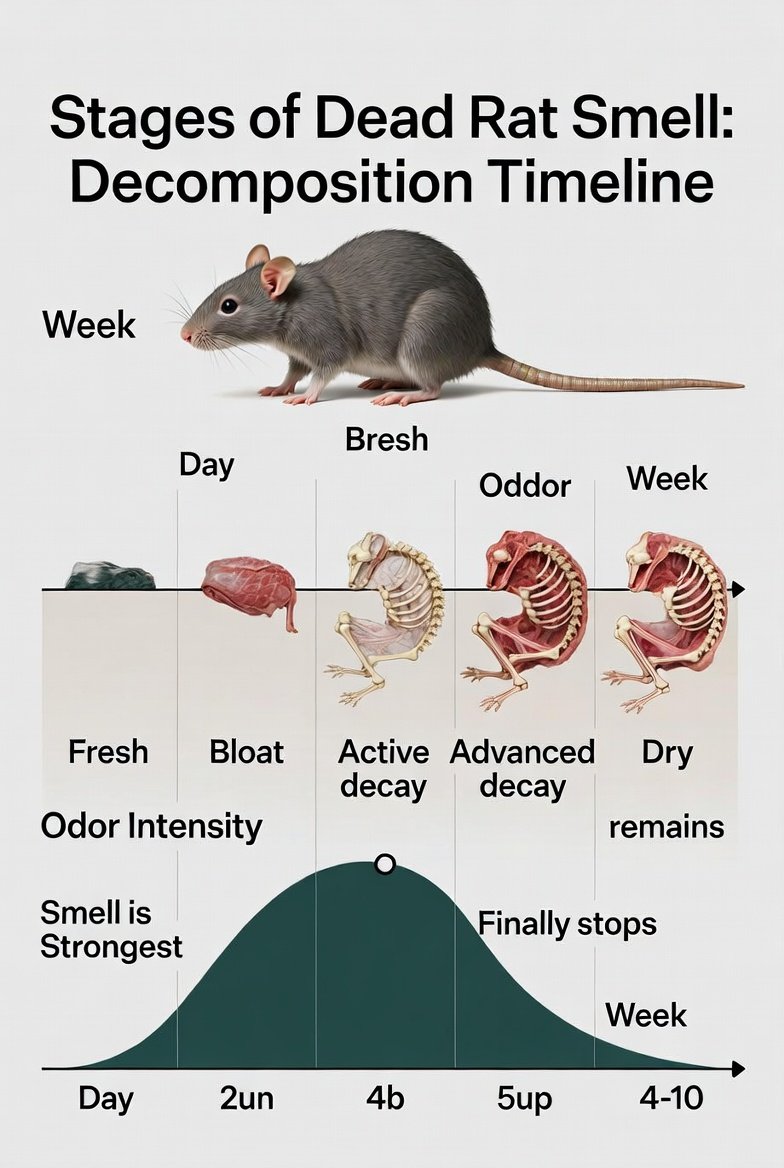
Dead rat odor follows a predictable biological pattern.
It intensifies sharply before it fades.
Misunderstanding that curve leads to unnecessary drywall demolition, insulation removal, and panic decisions during the worst-smelling days.
The smell changes in chemistry, intensity, and airflow behavior.
Understanding the stages prevents structural overreaction.
If scratching preceded the odor, review wall nesting behavior first:
rat nest in wall
Quick Stage Snapshot
Stage | Timeframe | Odor Level | What’s Happening |
Stage 1 | 0–24 hrs | Mild / Metallic | Early cellular breakdown |
Stage 2 | 24–72 hrs | Increasing | Gas buildup (bloat phase) |
Stage 3 | 3–7 days | Severe Peak | Active tissue decay |
Stage 4 | 7–14 days | Strong but declining | Tissue collapse |
Stage 5 | 14–30+ days | Fading / Musty | Dry decay & absorption |
Peak odor usually occurs between Day 3 and Day 7.
After peak, intensity declines sharply.
What Causes the Smell? (Biological Mechanism)
Dead rat odor results from:
- Sulfur-containing gases
• Putrescine and cadaverine (protein breakdown compounds)
• Nitrogen compounds resembling ammonia
• Fatty acid degradation
The sharp “burning” smell during peak phase comes from gas expansion.
The heavier lingering smell often results from tissue fluids absorbing into insulation or wood framing.
This explains why odor worsens before it improves.
Stage 1 — Early Decomposition (0–24 Hours)
Odor is faint.
Often described as:
- Slightly metallic
- Sour
- Hard to pinpoint
Wall cavities may trap the odor, making it barely noticeable at first.
Stage 2 — Bloat Phase (24–72 Hours)
Internal gases build pressure.
Odor increases rapidly.
This is typically when homeowners first detect a problem.
Smell is usually localized to one wall, ceiling zone, or attic corner.
Stage 3 — Active Decay (Peak Odor Phase)
Days 3–7.
This is the strongest stage.
Odor becomes penetrating, heavy, and difficult to ignore.
Most premature drywall cutting happens during this window.
The intensity is temporary.
Insect Activity Timeline (Location Confirmation Signal)
Blowflies detect decomposition quickly.
Day | Insect Signal |
1–3 | Flies near windows |
3–6 | Maggots active inside cavity |
5–10 | Increased indoor fly presence |
10+ | Fly activity declines |
If flies cluster repeatedly near one wall, vent, or light fixture, cavity location becomes more certain.
This signal is often more reliable than following odor direction.
Stage 4 — Tissue Collapse (7–14 Days)
Odor begins to decline.
Smell shifts from sharp to musty.
Many homeowners report noticeable improvement after Day 8–10.
This is normal biological progression.
Temperature Adjustment Model
Heat accelerates decomposition.
Location | Summer Timeline | Winter Timeline |
Attic (120°F+) | 3–10 days total | 2–4 weeks |
Wall cavity | 7–21 days | 3–5 weeks |
Crawlspace | 10–30 days | 4–6 weeks |
Hot attics move through stages quickly.
Cool wall cavities extend odor duration.
Wall vs Attic vs Crawlspace Differences
Location | Odor Spread | Duration | Intervention Likelihood |
Attic | Diffuse | Shorter | Rarely open ceiling |
Wall cavity | Localized | Moderate | Possible drywall cut |
Crawlspace | Trapped, heavy | Longer | Access removal likely |
Attics ventilate naturally.
Wall cavities trap odor more intensely.
Insulation Behavior
Fiberglass insulation:
• Less absorbent
• Faster odor dissipation
Cellulose insulation:
• More moisture-retentive
• Can hold odor longer
• May require partial replacement if saturated
If insulation contamination suspected:
Airflow & HVAC Spread Explained
Odor may be strongest upstairs even if the carcass is downstairs.
Reasons include:
- Stack effect (warm air rising)
• Shared stud cavities
• Return air chases
• Pressure imbalances
Closing vents can sometimes increase pressure differences and intensify odor migration.
Smell location does not always equal carcass location.
Open vs Wait — Decision Table
Condition | Wait | Open Wall |
Day 3–7 strong odor | ✓ | ✗ |
Smell declining after Day 8 | ✓ | ✗ |
Severe odor >21 days | ✗ | ✓ |
Liquid stain visible | ✗ | ✓ |
Flies concentrated in one area | ✗ | ✓ |
Multiple rooms smell | ✓ (check airflow first) | ✗ |
Most single-carcass cases resolve without cutting drywall.
When Professional Removal Makes Sense
Escalate when:
- Severe odor persists beyond 3 weeks
• Fluid staining appears
• Insulation saturation confirmed
• HVAC spreads odor through multiple rooms
For structural extraction:
rodent removal
Limitations
Applies to:
- Single carcass events
• Standard residential framing
• Normal seasonal temperatures
Does not apply to:
- Large infestations
• Flooded crawlspaces
• Severe moisture-damage conditions
Decision Matrix
Smell <7 days → Monitor
Smell improving after peak → Wait
Smell >21 days strong → Inspect cavity
Stain + flies localized → Controlled opening
Bottom Line
Dead rat smell follows biological stages.
It worsens before it improves.
Peak odor typically lasts only a few days.
Understanding the timeline prevents unnecessary structural damage.